
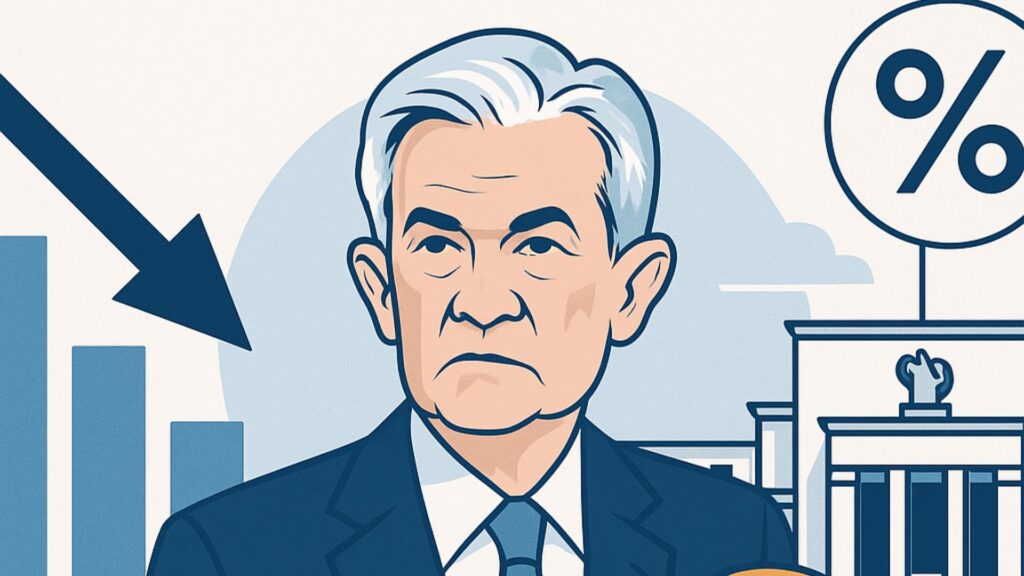
The latest decision from the Federal Reserve to cut interest rates once more has drawn significant attention across global markets.
Although the move aligns with ongoing efforts to manage inflation and preserve employment stability, it also highlights a broader concern about the underlying health of the United States economy.
Jerome Powell’s statement made it clear that the rate cut is not a sign of confidence but instead a response to rising risks within the labour market and inflation that remains above target.
As a result, investors, analysts, and institutions now look closely at the reasoning behind the decision and what it signals for the months ahead.
The Fed Lowers Interest Rates in December 2025
The December meeting of the Federal Open Market Committee resulted in a reduction of the federal funds rate by 0.25%.
Jerome Powell explained that the Committee remains committed to two key responsibilities, which are maintaining stable prices and supporting maximum employment.
Despite the limited availability of recent federal data, Powell stated that public and private indicators suggest little change in the overall economic outlook since October.
Activity remains moderate, supported by consumer spending and business investment, while the housing sector continues to struggle.
The labour market is now showing clearer signs of deceleration. According to Powell, job gains have slowed notably, and unemployment reached 4.4% in the most recent published report.
The slowdown is partly linked to reduced labour force participation and lower immigration, both of which contribute to weaker labour supply. At the same time, labour demand has softened.
Powell acknowledged that the risk of further weakness in employment has increased in recent months, prompting the Committee to take a more cautious stance.
Inflation remains higher than the preferred 2% target. The most recent figures show personal consumption expenditure prices rising 2.8% year on year, both for the headline and the core readings.
Powell noted that while inflation has eased significantly since its peak in 2022, progress has slowed in recent months. One of the key drivers behind the recent increase is the effect of tariffs on goods prices, while services inflation continues to ease gradually.
According to Powell, inflation expectations remain relatively stable, although the near-term indicators have shown some moderation.
The Fed’s updated projections show real GDP growth of 1.7% for this year and 2.3% for next year. Although these figures appear somewhat stronger than earlier forecasts, the Committee does not view them as evidence of a fully improving economy.
Instead, they continue to see a restricted environment with notable risks. Powell emphasised that the Committee will evaluate incoming data on a meeting-by-meeting basis, as monetary policy does not follow a predetermined course.
This approach reflects ongoing uncertainty surrounding inflation, employment, and broader economic momentum.
In addition to cutting rates, the Fed announced that it will begin purchasing shorter-term Treasury securities. These purchases are designed to maintain an ample supply of reserves in the financial system.
Powell stressed that this is purely an operational action for monetary policy implementation and should not be interpreted as a shift in policy direction.
The New York Fed outlined initial purchases of $40 billion in the first month, which may continue at higher volumes as needed to relieve pressures across money markets.
The vote within the Committee revealed differing views. While the majority supported a 0.25% reduction, Stephen Miran preferred a 0.50% cut, and two other members preferred no change.
The divergence of opinions highlights the complexity of the current environment and the differing interpretations of economic risks within the Committee.
Understanding the FOMC Statement and Economic Outlook
The FOMC statement released on the same day provides a clearer picture of the considerations behind the latest policy move.
The Committee acknowledges that economic activity continues to expand at a modest pace but also confirmed that job gains slowed throughout the year.
The unemployment rate has increased steadily, and early indicators suggest similar developments in the months following September. Inflation, meanwhile, has increased relative to earlier in the year and remains above target.
The statement places strong emphasis on the balance of risks. Downside risks to employment have increased, while the persistence of inflation pressures presents challenges for the Committee’s capacity to stabilise the economy.
As a result, the Committee decided that a 0.25% reduction in the target range, to between 3.5% and 3.75%, was the most suitable response.
The Fed reiterated its commitment to restoring inflation to 2% over time. The Committee highlighted the need for continuous monitoring of incoming information and stated that additional adjustments may be made if new risks emerge.
These risks include labour market conditions, inflation pressures, inflation expectations, financial developments, and international conditions.
A notable section of the statement addresses the status of reserve balances within the financial system. The Committee concluded that reserves had declined to the point where additional purchases were required to maintain smooth functioning.
This explains the upcoming short-term Treasury purchases. The Committee also removed the aggregate limit on standing repurchase operations, expressing confidence that these tools should be used whenever they support policy implementation.
The FOMC statement underscores that the Committee remains prepared to respond to evolving risks. While the rate cut is designed to provide support, it is not presented as a sign of economic strength.
Rather, it is a measure taken in response to pressures that may worsen if left unaddressed. The Committee acknowledges the elevated uncertainty surrounding the economic outlook and aims to manage these conditions carefully.
Overall, the FOMC statement reinforces Powell’s message that monetary policy decisions will be made gradually and based on real-time developments.
The combination of inflation that has not returned to target and labour market indicators that continue to weaken makes it clear why the Committee adopted a more cautious and defensive policy position.
Conclusion
The rate cut announced in December reflects a strategic response to mounting economic pressures rather than confidence in a strengthening recovery. With unemployment rising, inflation above target, and several indicators pointing to limited momentum, the Federal Reserve aims to reduce the risk of further deterioration while still working toward its long term objectives. Both Powell’s statement and the FOMC release show a careful and measured stance focused on stability. For policymakers, analysts, and institutions, the coming months will be shaped by new economic data that will determine whether further adjustments are needed.