
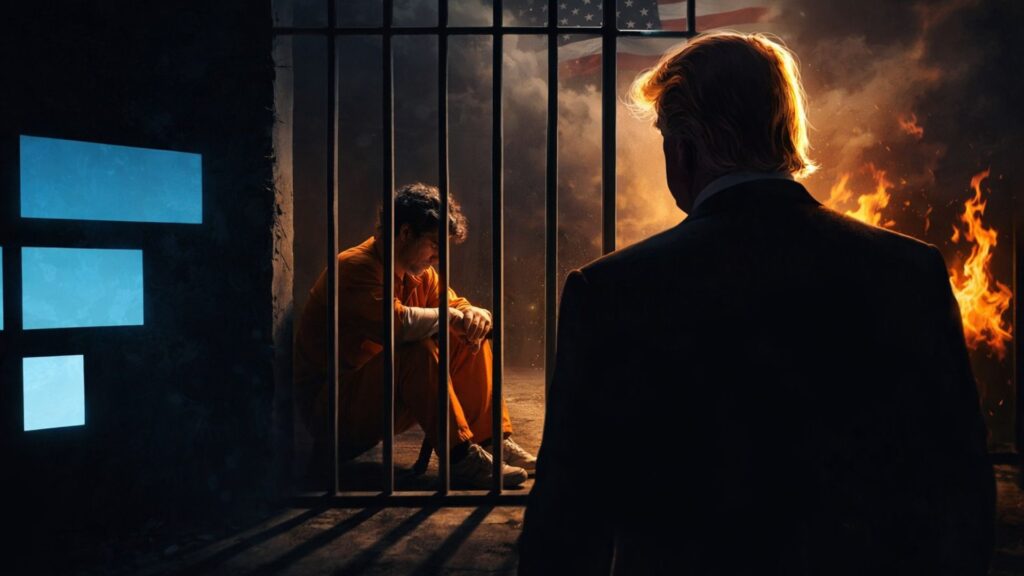
The question of whether Sam Bankman-Fried might one day walk free has lingered in crypto circles for years, fuelled by political shifts and a series of high-profile pardons tied to the industry. That speculation has now been brought to an abrupt end.
In a wide-ranging interview with the New York Times, President Donald Trump made it clear that he has no intention of using his presidential powers to pardon the former FTX chief.
The statement matters not just because it closes a legal door for one individual, but because it sends a broader signal about accountability in crypto. For an industry still dealing with the scars of past collapses, Trump’s words carry weight well beyond a single case.
Trump Makes His Position Clear on the SBF Pardon Question
Trump’s refusal to pardon Sam Bankman-Fried came during an interview that covered a range of political and legal issues.
When asked about the use of presidential clemency, Trump grouped Bankman-Fried alongside other high-profile figures he does not intend to help, including entertainment and political names unrelated to crypto. The message was blunt. There would be no exception made for the former exchange executive.
This stance is notable precisely because Trump has previously shown a willingness to extend clemency to individuals connected to the digital asset sector.
Since returning to office, he has pardoned figures such as Ross Ulbricht, as well as former executives from BitMEX and Binance. In those cases, Trump framed his decisions as a response to what he described as excessive enforcement or political targeting under previous administrations.
SBF’s case, however, sits in a different category. Convicted on multiple fraud and conspiracy charges, he received a 25 year prison sentence tied to the misuse of billions of dollars in customer funds at FTX.
The collapse of the exchange in late 2022 sent shockwaves through the entire crypto market, wiping out user savings, freezing withdrawals across connected platforms, and triggering a wave of regulatory scrutiny that continues to shape policy today.
Behind the scenes, there had been persistent reports that Bankman-Fried’s family and legal team were exploring possible clemency routes. His parents, both respected law academics, were said to have engaged with lawyers and political figures linked to Trump’s orbit.
Sam himself appeared in interviews and public commentary that many interpreted as an attempt to reframe his image.
Trump’s comments suggest those efforts failed to gain traction. While the president openly acknowledged that his support for crypto has been politically beneficial, he drew a clear line between backing the industry and excusing conduct that resulted in widespread financial harm.
In doing so, he effectively closed the door on one of the last remaining non-judicial paths available to the former FTX chief.
Why the FTX Collapse Defines Crypto’s Accountability Problem
The strength of the reaction to Bankman-Fried’s case cannot be separated from the scale of damage caused by FTX.
Unlike earlier crypto scandals that were often framed as technical failures or regulatory grey areas, the FTX collapse was widely perceived as a straightforward breach of trust. Customer funds were misused, internal controls were absent, and basic governance principles were ignored.
For many investors, this was not a story about innovation colliding with outdated rules. It was a story about deception.
That distinction matters when assessing why political mercy feels inappropriate to large parts of the crypto community itself.
Even among long-time industry participants who oppose heavy-handed regulation, there is little appetite to defend actions that undermined the credibility of the entire sector.
The fallout from FTX reshaped crypto in practical ways. Exchanges faced renewed pressure to publish proof of reserves.
Venture capital funding slowed as trust eroded. Regulators across the United States, Europe, and Asia accelerated enforcement efforts, often citing FTX as a cautionary example.
For everyday users, the episode reinforced a hard lesson about counterparty risk and the limits of reputational trust.
Against that backdrop, Trump’s refusal to pardon Bankman Fried can be read as a recognition of how deeply the case resonated beyond politics.
Granting clemency might have been interpreted as minimising the harm suffered by millions of users and investors. It could also have undermined attempts to position crypto as a more mature and accountable financial sector.
There is also a longer-term consideration. High-profile consequences play a role in shaping behaviour.
The severity of Bankman-Fried’s sentence, combined with the absence of political rescue, sets a precedent that misconduct at scale will not be quietly forgiven. For founders and executives operating today, that reality may serve as a deterrent stronger than any new rulebook.
This does not mean that the industry has resolved its governance problems. Centralised platforms still hold enormous power over user assets, and transparency remains uneven.
But the refusal to extend mercy in this case draws a boundary. It separates ideological debates about regulation from basic expectations around honesty and custody.
In that sense, the end of pardon speculation may help crypto move forward. It closes a chapter defined by excess and forces attention back onto building systems that do not rely on individual goodwill or political favour. Accountability, rather than personality, becomes the anchor.
Conclusion
Trump’s decision to rule out a pardon for Sam Bankman-Fried is more than a personal setback for a disgraced executive. It is a statement about where responsibility begins and ends in crypto.
While political winds can shift and enforcement philosophies can change, some actions carry consequences that even presidential power will not undo. For an industry still rebuilding trust, that clarity may prove uncomfortable but necessary.