
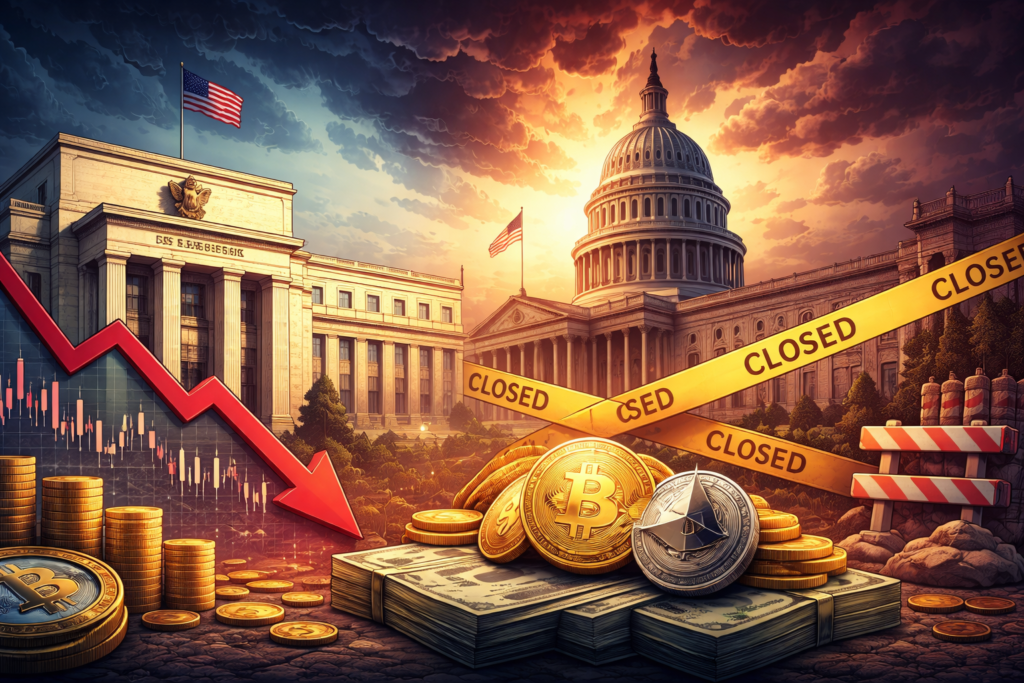
The final week of January 2026 has delivered a familiar mix of monetary caution and political uncertainty. The Federal Reserve has chosen to hold interest rates steady, signalling confidence in the economy’s underlying resilience while acknowledging lingering inflation pressures.
At the same time, Washington is once again facing the prospect of a partial government shutdown, with negotiations over Department of Homeland Security funding threatening to disrupt federal operations.
Together, these developments are shaping investor sentiment across global markets, including digital assets, where uncertainty rather than conviction has been the dominant theme in recent sessions.
The Federal Reserve’s Decision to Hold Rates Steady
The Federal Reserve’s latest policy decision was broadly in line with expectations. The Federal Open Market Committee opted to maintain the target range for the federal funds rate at 3.5% to 3.75%, extending the pause that followed three consecutive rate cuts late last year.
Chair Jerome Powell framed the decision as a reflection of balance rather than complacency. Economic activity, according to the Fed, continues to expand at a solid pace, supported by resilient consumer spending and steady business investment, even as certain sectors such as housing remain under pressure.
Labour market conditions played a central role in the Committee’s assessment. Job gains have slowed materially, and recent data suggest the unemployment rate may be stabilising rather than deteriorating further.
Powell highlighted that part of this slowdown reflects structural factors, including reduced labour force growth due to lower immigration and participation. At the same time, softer labour demand is beginning to ease pressure on wages, reducing the risk of a renewed inflation surge.
Inflation remains above the Fed’s 2% target, but the trajectory is moving in the right direction. Core inflation measures have eased significantly since their 2022 peaks, even though recent tariff-related pressures have kept goods inflation elevated. Services inflation, by contrast, continues to cool.
For policymakers, this combination supports a wait-and-see approach. Monetary policy is now closer to what the Fed considers a neutral stance, and officials are reluctant to move too aggressively in either direction without clearer evidence.
For markets, this posture has reinforced a sense of caution. While the absence of further rate cuts removes one potential catalyst for risk assets, the decision also limits downside fears of renewed tightening.
In crypto markets, this has translated into muted price action and reduced risk appetite. Digital assets tend to react not just to rate levels but to changes in expectations, and the Fed’s message of patience has left traders without a strong directional signal.
The result has been a broadly defensive tone, with investors prioritising capital preservation over speculative positioning.
The Growing Risk of a Partial Government Shutdown
Alongside monetary policy, political developments are adding another layer of uncertainty. The current continuing resolution funding the US government is set to expire at the end of January, and negotiations have stalled over appropriations for the Department of Homeland Security.
Senate Democrats have signalled they will not support the existing funding proposals without changes, following a series of controversial law enforcement incidents. Republicans, for now, appear unwilling to compromise, raising the likelihood of at least a short-lived partial shutdown.
Even if a shutdown does occur, its immediate economic impact may be limited. Several major agencies, including those responsible for food assistance, veterans’ affairs, and parts of defence spending, already have full-year funding in place.
However, other departments such as State, Transportation, Health and Human Services, and Labour could face operational disruptions. Historically, these episodes tend to weigh more on sentiment than on near-term economic output, but that does not make them irrelevant for markets.
Political risk of this kind reinforces a broader theme of unpredictability in the policy environment. For investors, uncertainty around fiscal governance can complicate forecasts for growth, public spending, and regulatory priorities. In risk-sensitive markets, this often leads to a temporary retreat from exposure.
Crypto assets, which already sit outside traditional safety frameworks, are particularly sensitive to shifts in confidence. While they are sometimes framed as alternatives to government-issued money, they still depend heavily on global liquidity conditions and investor psychology.
The current backdrop has encouraged a more defensive stance across digital markets. Traders are wary of taking large positions while fiscal negotiations remain unresolved, especially with memories of past shutdowns still fresh.
Even the perception of dysfunction in Washington can amplify volatility, as investors reassess their assumptions about macro stability.
In this context, recent weakness in crypto prices reflects not a single negative catalyst, but a convergence of unresolved questions around policy, growth, and governance.
Conclusion
The end of January 2026 finds markets navigating a delicate balance between reassurance and risk. The Federal Reserve’s decision to hold rates steady suggests confidence in the economy’s underlying strength, but also highlights the fragility of progress on inflation and employment.
At the same time, the renewed threat of a partial government shutdown underscores the persistent role of political uncertainty in shaping market sentiment.
For crypto markets, these dynamics have combined to produce a cautious, slightly bearish tone, driven less by fundamentals and more by hesitation.
Until greater clarity emerges on both monetary and fiscal fronts, uncertainty is likely to remain the defining feature of the market landscape.