

In recent months, a new concept called x402 has begun to reshape how artificial intelligence interacts with online services.
It is an open payment protocol that allows AI agents and applications to make transactions automatically using stablecoins such as USDC.
Instead of relying on traditional accounts or subscription models, x402 enables direct, real-time payments between AI systems and web platforms.
This creates an entirely new way for digital tools to operate, where they can access, purchase, and exchange information without any human involvement.
What is the x402 Narrative?
The story of x402 starts with a simple idea. It is based on the old web status code “HTTP 402 Payment Required,” which was originally intended to allow websites to request payment before granting access.

That code was never widely used, but x402 brings it back to life by combining it with cryptocurrency payments. It allows any web service to charge users, or even AI agents, directly for access without needing sign-ups or stored payment details.
In technical terms, when an AI agent asks for a service or data, the server can respond with a “Payment Required” message.
The agent then sends the correct amount in USDC and instantly receives the data. This process happens automatically through code. The result is a more efficient, private, and permissionless form of digital commerce that does not depend on cards, logins, or intermediaries.
The idea was developed through collaboration between Coinbase and Cloudflare, which launched the x402 Foundation to promote the protocol. Its goal is to make payments as easy for AI as clicking a link is for humans.
Any service can now charge for what it provides directly through x402, which can work across any blockchain. In this way, AI tools, web applications, and APIs can finally exchange value as freely as they exchange information.
x402 is more than a new payment tool. It is a shift in how the internet can work. It introduces a way for intelligent systems to participate in the economy by paying for exactly what they use, when they use it, and nothing more.
How Does It Enhance AI Agents?
AI agents today can process data and respond to instructions, but they cannot easily access paid services. Many online tools and APIs still require manual sign-ups, account verification, and prepaid credit.
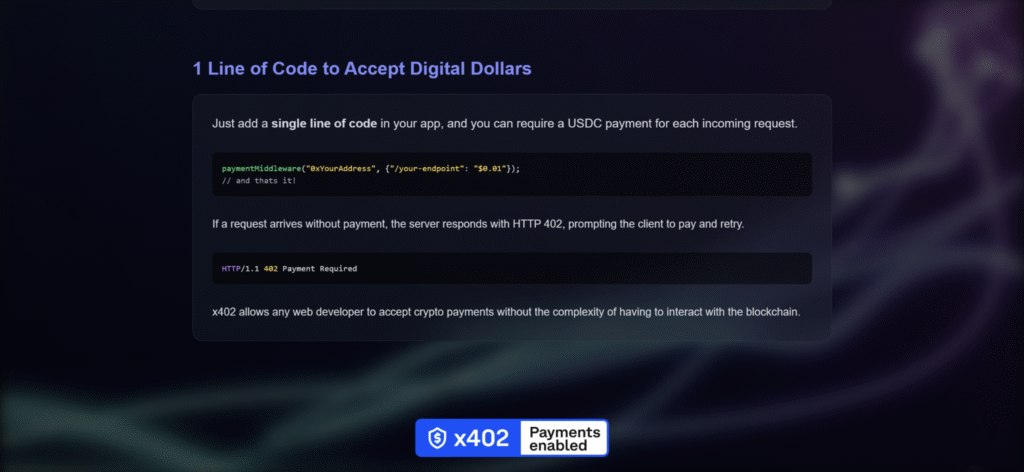
x402 removes all of that friction. It gives AI agents the ability to pay automatically whenever they need information, access, or computing resources.
This makes AI agents far more capable and autonomous. For example, an agent could analyse market data by purchasing access to different APIs, compare insights, and generate a report, all without human action.
Each step of that process would trigger tiny, precise payments handled by x402. This approach supports micropayments, so even fractions of a cent can be transferred to pay for a single query or dataset.
Micropayments are one of the most powerful features of x402. They make it practical to monetise small pieces of content or services that were too cheap to sell before.
A news provider could charge one cent per article, or a data source could sell access by the request instead of by subscription.
These small payments accumulate over time and make business models more flexible for both creators and users.
x402 also improves transparency. Because transactions use stablecoins on-chain, every payment is verifiable.
This provides clear records for auditing and dispute resolution, but still protects user privacy since payments are tied to wallet addresses rather than names.
For AI agents, this means a new kind of financial independence. They can make decisions about what data or tools to purchase based on cost and need, rather than waiting for human approval.
It creates what many call “economic intelligence”, the ability for software to manage its own resources efficiently and responsibly.
In simple terms, x402 transforms AI from being just analytical to being economically active. Agents can now explore, decide, and pay on their own, creating a new class of self-sustaining digital systems.
The x402 Ecosystem
Since its introduction, x402 has grown into a diverse ecosystem of platforms, developers, and services that use the protocol to enable new kinds of digital interaction.
The official x402 website lists dozens of active projects, from AI data providers to infrastructure developers, all building on this shared standard.
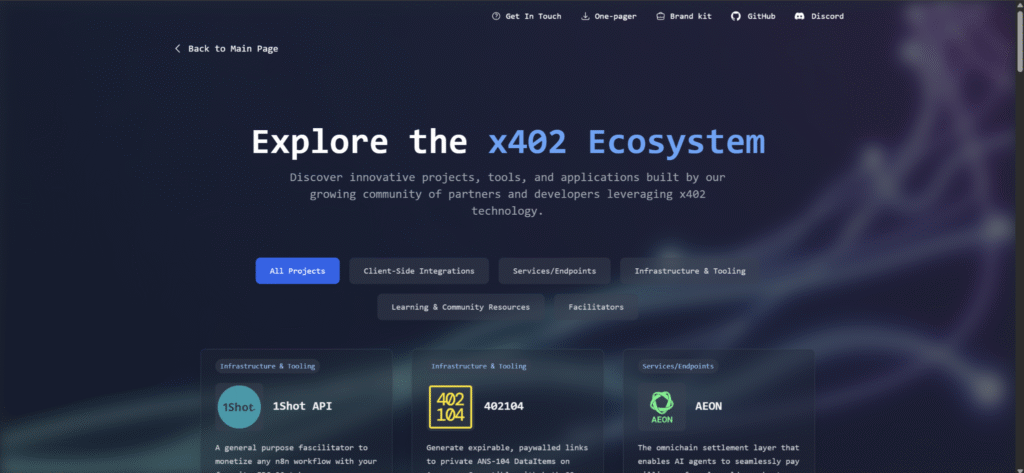
Some projects focus on helping developers adopt x402 quickly. Tools like Axios and Fetch clients allow easy integration for web applications. There are also Java and TypeScript software development kits for those building AI systems that can make x402 payments directly.
On the service side, companies are already using x402 to power real-world applications. Fluora has created a marketplace where AI agents can buy and sell digital services.
Gloria AI provides real-time data feeds for agents that need accurate and timely information. Firecrawl offers a web scraping API that allows AI to collect website data automatically, paying only for what it retrieves.
Several platforms are expanding the scope of x402 by connecting it to global commerce. AEON acts as an omnichain settlement layer that lets AI agents pay merchants across different regions, including Southeast Asia and Latin America.
Other facilitators, such as PayAI and CDP Facilitator, help process payments safely and efficiently across multiple blockchains.
Infrastructure projects are making x402 easier to use for developers. Proxy402 lets people create paid links to their own content, while Daydreams Router provides x402-enabled access to language model inference, allowing AI to pay for computation as needed.
The ecosystem also includes learning resources and open-source repositories. Developers can find examples and guides in the x402 Example Gallery, which demonstrates integrations with popular frameworks.
This growing body of documentation helps lower the barrier for new builders to enter the x402 economy.
Each project plays a specific role in building a functioning payment network for AI. Some handle transactions, others provide data, while others focus on building marketplaces.
Together, they form the foundation of an internet where AI and software can interact financially as smoothly as they exchange messages.
What makes this ecosystem unique is that it is open to everyone. x402 is not controlled by a company. It is an open standard, licensed for anyone to use and expand.
This allows developers to build their own facilitators, host their own payment servers, and customise how their systems charge or receive payments. It mirrors the spirit of the early internet, open, collaborative, and built on shared standards rather than centralised platforms.
The presence of stablecoins such as USDC adds reliability, while the use of public ledgers ensures accountability. As more services join, the x402 network becomes more connected, giving AI agents access to a growing web of interoperable, pay-per-use services.
Conclusion
x402 represents a major step toward a more dynamic and accessible digital economy. It turns the long-unused concept of “Payment Required” into a living part of the internet, enabling machines to pay each other for information, data, and services in real time.
By allowing AI agents to act independently, it helps unlock a new level of functionality and efficiency across industries.
As more developers and companies adopt this standard, the web begins to look less like a place filled with locked gateways and more like a free market where value flows instantly.
x402 may still be new, but its principles are simple: direct, open, and fair exchange between intelligent systems. If the growth of its ecosystem continues, it could redefine how both humans and AI interact with the internet.