
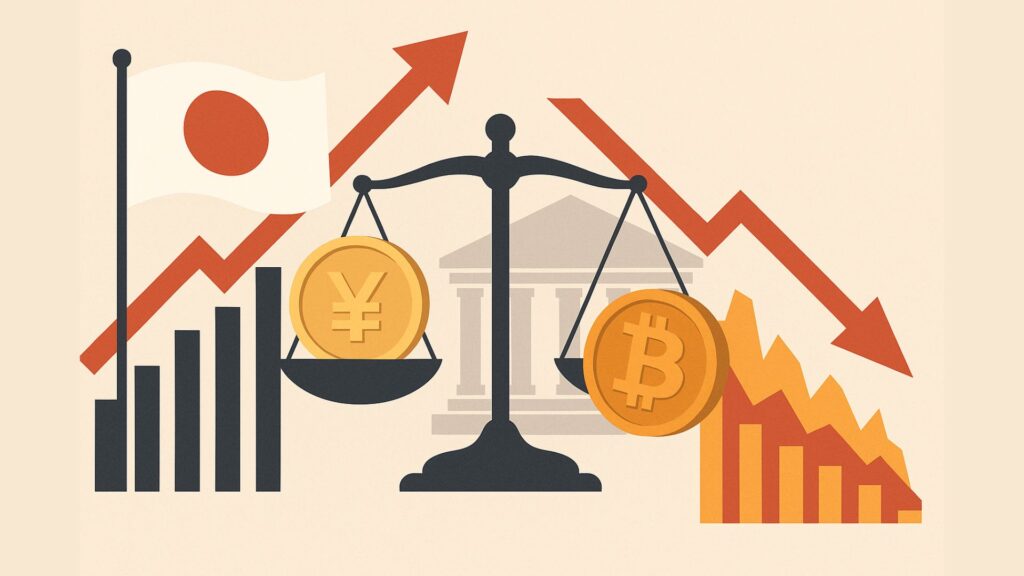
Bitcoin entered the new week under pressure after a major shift in Japan’s monetary outlook sent waves through global markets.
The Bank of Japan signalled that it may raise interest rates at its upcoming meeting on 18 to 19 December, and this possibility was strong enough to move currencies, government bonds, and the global appetite for risk.
With Japanese yields rising to their highest levels since 2008 and the yen strengthening, liquidity in Asia tightened quickly. Bitcoin reacted almost immediately, falling below $87,000 during early Asian hours as leveraged positions unwound.
This market reaction did not come from within the crypto sector. It came from Japan’s changing policy direction and the effect this has on one of the most important mechanisms in global markets: the yen carry trade.
Japan’s Policy Direction and Why Markets Expect a Rate Hike
The most influential development this week was a clear message from Kazuo Ueda, the governor of the Bank of Japan. Speaking to business leaders in Nagoya, he stated that the central bank will examine the “pros and cons” of raising interest rates in December.
This phrasing was stronger than anything said in previous months and immediately convinced traders that a hike was now a realistic possibility.
The context behind Ueda’s message is significant. He explained that the central bank must assess whether wage increases across companies are sustainable. Wage growth is a key condition for achieving stable inflation of 2% in Japan.
He also mentioned that labour shortages are becoming more noticeable and that corporate profits remain healthy.
The Bank of Japan has been gathering wage data from companies in every region, suggesting that Japan is approaching the point where ultra low interest rates may no longer be appropriate.
His remarks were enough to move markets within minutes. The yen strengthened by 0.4% to 155.49 per dollar, reflecting expectations of tighter policy.
The yield on the 10 year Japanese government bond climbed to 1.84%, the highest since 2008. The 2 year yield reached 1.01%, a level not seen in 17 years. These increases reflect how strongly traders believe the Bank of Japan may act on 18 to 19 December.
Ueda also explained that even with a rate increase, borrowing costs would remain low because real interest rates are still deeply negative. In other words, the central bank would not be slowing the economy.
Instead, it would be reducing the intensity of monetary support. He likened the situation to easing off the accelerator rather than applying the brakes.
This shift matters for global markets because Japan has maintained near zero or negative interest rates for more than a decade. The predictability of this environment has shaped global capital flows.
When the Bank of Japan signals that a change is coming, even a small one, the rest of the world reacts quickly.
Ueda added that Japan must not raise rates too early or too late. He said the timing must support long term growth and stable inflation.
He also warned that a weak yen can increase consumer inflation by raising import costs, meaning the central bank must pay attention to currency movements.
Although Ueda left open the possibility of waiting until January, the tone of his remarks suggested that December is a serious option.
Analysts described his comments as preparing the market for a possible decision later this month. Once those remarks were absorbed, the effects flowed directly into asset markets, including Bitcoin.
Carry Trade Pressures and How They Affected Bitcoin
The yen carry trade sits at the centre of this story. For many years, Japan’s extremely low interest rates allowed investors to borrow yen cheaply and invest the funds into higher yielding assets. This strategy became a major source of liquidity for emerging markets, equities, and cryptocurrencies.
When Japanese yields rise and the yen strengthens, the carry trade becomes far less attractive. The cost of borrowing yen increases and the stronger currency makes it more expensive for investors to repay yen denominated loans.
When both conditions happen at once, investors begin to unwind the trade. This means they sell risk assets and buy yen to close their funding positions.
The impact on Bitcoin became visible almost immediately. During the Asian trading session, Bitcoin dropped from the $90,000 region to the $86,000 region as carry trade flows reversed.
Liquidations surged. More than $150 million in Bitcoin long positions were forced to close in a short period. The wider crypto market also felt the effect, with Ether falling towards $2,850 and long positions across major assets being liquidated.
This type of movement happens because cryptocurrencies rely heavily on liquidity conditions in Asia. When the cost of capital in Japan increases, speculative flows linked to the yen begin to shrink.
Order books become thinner, volume decreases, and sudden selling produces sharper declines. This is exactly what happened when Japanese yields climbed above their multi year highs.
The market behaviour also shows that traders were using significant leverage before the decline. When carry trade funding becomes more expensive, leveraged positions become riskier.
The combination of rising funding costs and falling asset prices increases the probability of forced liquidations. This creates a chain reaction, where selling pressure triggers additional liquidations, amplifying the price decline.
Bitcoin’s drop this week therefore reflects more than sentiment. It reflects a structural adjustment in global liquidity. As long as the market expects a rate increase in Japan, carry trade activity will remain limited.
This reduces the short term appetite for risk in the Asian session and keeps cryptocurrencies exposed to volatility.
Looking ahead, everything now depends on what the Bank of Japan decides on 18 to 19 December. If a rate increase happens, the carry trade could unwind further, creating another period of volatility for Bitcoin.
If the Bank of Japan waits until January, markets may stabilise temporarily. However, uncertainty will remain until the policy path becomes clearer.
Conclusion
Bitcoin’s decline this week was driven by Japan’s shifting monetary policy and the sudden pressure on the yen carry trade.
As the Bank of Japan signalled that it will consider raising interest rates on 18 to 19 December, yields climbed and the yen strengthened. This forced investors to unwind carry trade positions, reducing liquidity and creating selling pressure across risk assets.
With more than $150 million in Bitcoin long positions liquidated and volatility rising during Asian hours, traders should approach the market with caution. Until Japan’s policy direction becomes clearer, managing risk is essential to avoid sudden price swings linked to global liquidity changes.