
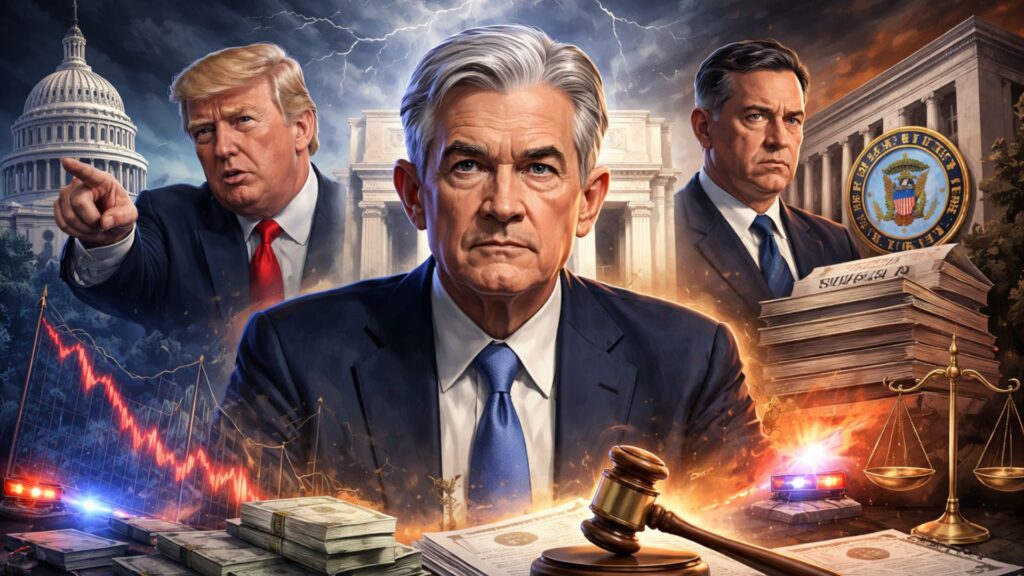
The past week has placed Federal Reserve Chair Jerome Powell at the centre of one of the most unusual and politically charged moments in modern US economic history.
What began as a routine dispute over interest rates has escalated into a criminal investigation that now threatens to blur the boundary between law enforcement, politics, and central bank independence.
At stake is not only Powell’s personal position but the credibility of the Federal Reserve as an institution tasked with steering the world’s largest economy through uncertainty.
Powell’s FOMC Statement and the Question of Central Bank Independence
Powell’s recent statement following the Federal Open Market Committee meeting was unusually direct, both in tone and intent. Rather than focusing solely on inflation, employment, or growth risks, he addressed the legal pressure facing him head-on.
According to Powell, the Department of Justice’s actions are not fundamentally about the renovation of the Federal Reserve’s historic headquarters, nor about congressional oversight.
Instead, he framed the situation as a broader test of whether monetary policy decisions can remain grounded in economic evidence rather than political preference.
This is a significant departure from the carefully neutral language typically used by Fed chairs. Powell emphasised that interest rates are set with a mandate focused on price stability and maximum employment, not on appeasing the White House.
By doing so, he implicitly warned markets and lawmakers that the independence of the central bank is being challenged in real time. His remarks suggested that the legal pressure could set a precedent where policy decisions are influenced by intimidation rather than data.
From a market perspective, this shift in communication matters. The Federal Reserve’s authority relies heavily on trust.
Investors, businesses, and global counterparts assume that decisions are insulated from partisan battles. Powell’s decision to speak openly about political pressure introduces uncertainty into that assumption.
While transparency can reassure some observers, it also signals that institutional norms may be under strain.
The timing compounds the issue. The US economy is navigating slowing growth, fragile labour markets, and lingering inflation risks. In such an environment, clarity from the Fed is critical.
Powell’s statement was meant to reinforce credibility, but it also highlighted how fragile that credibility could become if legal and political pressures continue to escalate.
The Criminal Investigation and Trump’s Escalating Pressure
The investigation itself centres on Powell’s June testimony to Congress regarding a roughly $2.5 billion renovation of the Federal Reserve’s Washington headquarters.
Federal prosecutors have issued grand jury subpoenas to determine whether Powell misrepresented the scope or cost of the project. While no charges have been filed, the mere existence of a criminal probe into a sitting Fed chair is unprecedented.
Powell has pushed back strongly, describing the renovation issue as a pretext rather than the true motivation behind the investigation. He argues that the legal threat emerged after sustained frustration from Donald Trump over the pace and scale of interest rate cuts.
Trump has repeatedly criticised Powell, accusing him of incompetence and claiming the central bank has kept rates too high for too long.
This confrontation reflects a broader political struggle. Trump has been vocal about his desire to reshape the Federal Reserve once Powell’s term as chair expires, and potential successors have already been discussed publicly.
Against this backdrop, the investigation risks being interpreted less as a neutral legal process and more as a tool within a wider campaign to influence monetary policy.
Reactions across Washington have been sharply divided. Some Republican lawmakers argue that no official should be immune from scrutiny, especially when public funds are involved.
Others, including members of Trump’s own party, have warned that the investigation undermines the credibility of both the Justice Department and the Federal Reserve.
Democratic leaders have been more direct, describing the probe as an attempt to bully an independent institution into submission.
Financial markets have not ignored the drama. The dollar has shown signs of weakness, and equity futures dipped following Powell’s public comments.
Analysts note that global investors are particularly sensitive to any indication that US institutions are becoming politicised. Even the perception of compromised independence can prompt a reassessment of risk across US assets.
For Powell personally, the path forward is unclear. While his term as chair ends in May, his role as a Fed governor extends beyond that date.
Whether he chooses to remain, step aside, or challenge the investigation more forcefully could shape the balance of power within the central bank for years to come.
Conclusion
The confrontation between Jerome Powell, the Justice Department, and the Trump administration marks a rare moment when monetary policy, law, and politics collide openly. Powell’s response has reframed the issue as a test of institutional independence rather than a narrow legal dispute.
As markets, lawmakers, and global observers watch closely, the outcome will influence not only the Federal Reserve’s credibility but also confidence in the stability of US economic governance itself.