
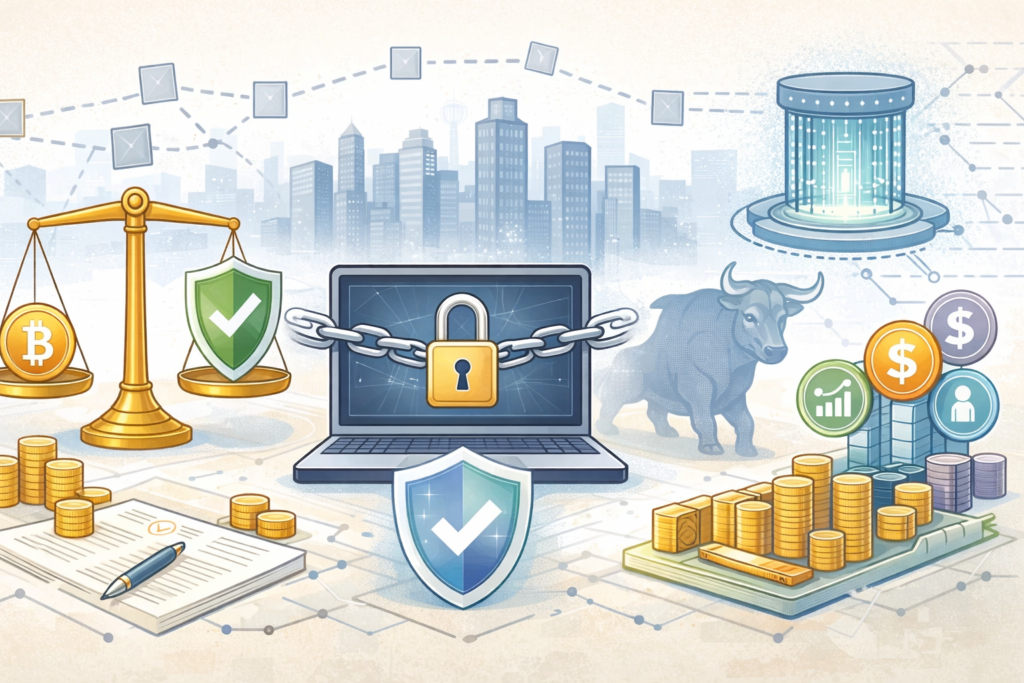
The crypto industry is entering a more reflective phase, where regulation, long-term security, and integration with traditional finance are being addressed in parallel rather than in isolation.
Recent developments around Zcash’s regulatory status, renewed discussions on quantum computing risks to blockchains, and Binance’s plans to revisit tokenised stocks all point to an ecosystem that is steadily maturing.
Rather than chasing rapid experimentation, the focus is shifting toward sustainability, compliance, and resilience. Together, these stories offer a clear snapshot of how blockchain technology is adapting to real-world constraints while continuing to expand its role in global finance.
Zcash and a More Nuanced Regulatory View on Privacy
The Zcash Foundation recently confirmed that the US Securities and Exchange Commission has ended its 2023 investigation into Zcash without pursuing enforcement action. The review examined whether Zcash’s privacy features raised concerns under existing securities laws.
After concluding its assessment, the SEC decided not to move forward, marking an important moment for privacy-focused blockchain projects.
Zcash, launched in 2016, was designed to give users control over transaction privacy through zero-knowledge proofs, while still operating on a public blockchain.
Its architecture allows both transparent and shielded transactions, enabling privacy without completely removing the possibility of compliance or auditability. This design has often been cited as a middle ground between full transparency and absolute privacy.
For years, privacy coins have faced disproportionate regulatory scrutiny, often due to assumptions rather than demonstrated misuse. The conclusion of the SEC’s review suggests that regulators may be becoming more precise in how they assess privacy technologies. Market reactions were largely positive, with increased trading activity reported shortly after the announcement.
More importantly, the decision may reduce uncertainty for developers and institutions exploring privacy-preserving tools within compliant frameworks.
Preparing Blockchains for the Long-Term Quantum Question
Beyond regulation, blockchain networks are also confronting questions about their long-term security, particularly in relation to quantum computing. Bitcoin and other major blockchains are frequently described as secure for now, but not permanently immune to future cryptographic breakthroughs.
The concern centres on digital signature schemes such as ECDSA, which could theoretically be compromised by sufficiently powerful quantum computers.
Despite these concerns, experts broadly agree that practical quantum attacks remain a distant scenario. This extended timeline gives blockchain communities space to research, test, and deploy post-quantum cryptographic solutions.
Bitcoin developers have discussed migration paths toward quantum-resistant signatures, while Ethereum and Solana have already begun experimental work to evaluate how such upgrades could be implemented without disrupting existing systems.
Rather than treating quantum computing as an immediate existential threat, most blockchain communities are approaching it as a gradual engineering challenge.
This mirrors how internet security standards have evolved, adapting to new threats as they emerge. The ability of decentralised networks to coordinate upgrades may ultimately determine how smoothly they transition if quantum capabilities advance faster than expected.
Tokenised Stocks and the Return of On-Chain Equities
While security discussions look far into the future, integration with traditional finance is happening in real time. Binance recently confirmed that it is still planning to offer tokenised stocks, years after its initial attempt was halted by regulators in 2021.
That early experiment, which included tokenised versions of major equities, ended after regulatory intervention, particularly in Europe.
Since then, Binance has shifted toward a more compliance-focused strategy, placing greater emphasis on regulatory engagement and structured product development.
According to the exchange, tokenised equities remain a logical extension of blockchain infrastructure, offering faster settlement, broader access, and reduced reliance on traditional intermediaries.
Binance is not alone in this direction. Other platforms have launched or explored similar offerings, while large institutions such as BlackRock have publicly highlighted tokenisation as a major theme for the coming years.
At the same time, traditional financial institutions like the New York Stock Exchange are developing blockchain-based settlement systems, reinforcing the idea that tokenisation is becoming part of mainstream financial planning rather than a niche experiment.
Conclusion
Taken together, these developments reflect a crypto industry that is steadily growing into its role as long-term financial infrastructure.
Regulatory decisions around Zcash suggest a more measured approach to privacy technologies. Ongoing research into quantum-resistant cryptography shows that blockchains are preparing for future risks rather than ignoring them.
Meanwhile, renewed interest in tokenised stocks highlights how digital assets are converging with traditional finance. While challenges remain, the broader direction is clear. Crypto is no longer defined solely by rapid disruption, but by its ability to adapt, comply, and endure.