
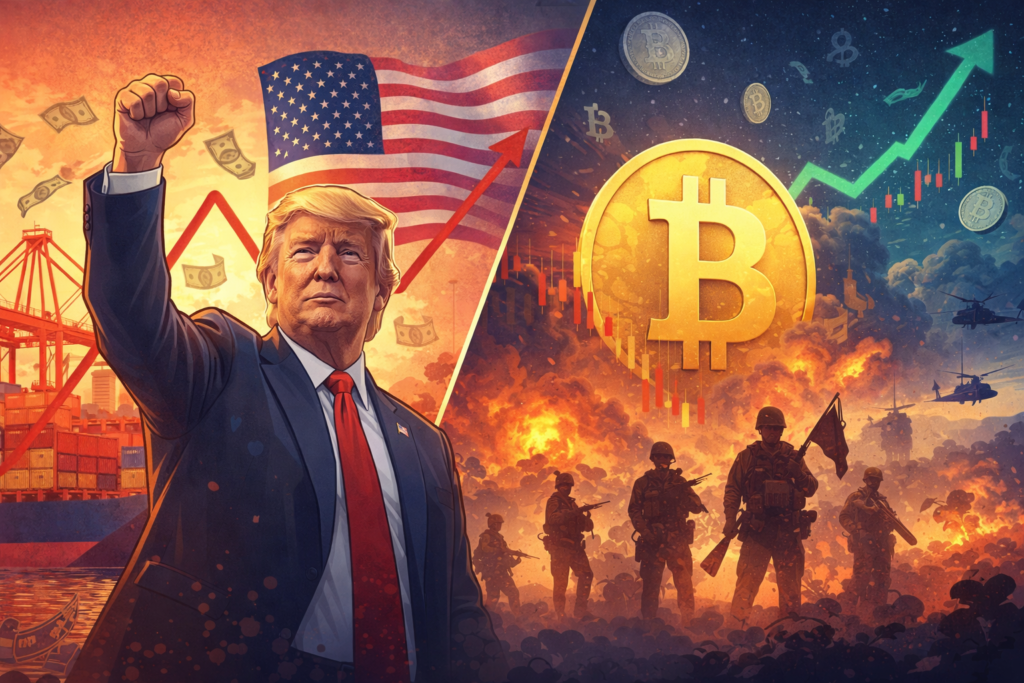
Donald Trump’s latest tariff decision has once again pulled global trade back into the spotlight. The US President announced that he is raising the global tariff rate from 10% to 15%, effective immediately. In previous cycles, similar trade headlines have rattled both equities and crypto.
This time, however, the reaction has been notably restrained. Despite the political noise and macro uncertainty, crypto markets have remained relatively steady. So what explains this apparent indifference?
The answer lies less in politics and more in how markets interpret risk, liquidity, and the broader macro narrative.
Why Trump’s Tariff Hike Did Not Shake Crypto Markets
Trump’s tariff policies and crypto markets are connected mainly through macroeconomic expectations rather than any direct mechanical link. When tariffs are raised, investors typically start pricing in higher trade tensions, supply chain disruptions, and potentially slower economic growth.
In traditional markets, this often triggers a reassessment of risk. Some capital moves into defensive assets, while others speculate that central banks might eventually respond to economic weakness with monetary easing.
Crypto, particularly Bitcoin, does not always behave in a uniform way during such periods. At times it trades like a classic risk asset, similar to technology stocks, falling when global growth fears intensify.
At other moments, it behaves more like a hedge against inflation, currency debasement, or capital controls that may emerge from prolonged trade disputes. The relationship is therefore conditional rather than fixed.
Tariffs influence crypto indirectly by shaping liquidity conditions, interest rate expectations, and overall investor sentiment. If markets believe that higher tariffs will lead to tighter financial conditions or a stronger US dollar, crypto can face pressure.
Conversely, if tariffs are interpreted as inflationary or destabilising for fiat currencies, the narrative can turn supportive for digital assets. In the current case, the market appears to view the tariff increase as a geopolitical adjustment rather than a systemic liquidity shock.
Another layer of connection comes from global capital flows and regulatory narratives. Trade wars and higher tariffs can fragment global financial systems.
For some investors, especially in emerging markets, this fragmentation encourages a search for borderless assets such as crypto, either as a store of value or as a payment rail that operates beyond traditional banking infrastructure.
However, tariffs can also strengthen the US dollar in the short term, as capital seeks safety. A stronger dollar typically weighs on crypto prices, since most digital assets are priced globally in USD.
In practice, markets often distinguish between immediate liquidity shocks and longer term geopolitical shifts. The current tariff move appears to fall into the latter category.
Traders may see it as part of a broader political strategy rather than an abrupt policy change that forces central banks to alter monetary conditions. As long as monetary policy expectations, global liquidity, and risk appetite remain broadly stable, crypto does not necessarily react strongly.
Legal Limits, Market Context, and the Bigger Macro Picture
In announcing the move, Trump said he would raise the global tariff rate from 10% to 15%, with immediate effect. He also repeated his criticism of the Supreme Court after it blocked his authority to impose tariffs under the International Emergency Economic Powers Act.
In a post on Truth Social, he stated that, as President of the United States, he would raise the 10% worldwide tariff on countries that had been “ripping” the US off for decades to a “legally tested” 15% level.
Earlier, he had already announced a 10% global tariff on top of existing tariffs that remained valid following the court ruling, using alternative legal frameworks under the Trade Expansion Act of 1962 and the Trade Act of 1974.
These details matter because they frame the move not as an unlimited escalation, but as one bounded by existing legal channels.
Pro crypto lawyer Adam Cochran pointed out that the relevant laws limit how broadly and for how long such tariffs can be applied.
According to him, the authority only allows action against countries with which the US runs a deficit, for a period of 150 days, and at a capped percentage. This suggests that the scope of the policy may be narrower than the headline implies.
Historically, fresh tariff announcements from Trump have shaken both crypto and equity markets, often triggering sharp sell offs. Heightened macro uncertainty can quickly translate into risk reduction across asset classes. Yet this time, the crypto market remained relatively steady despite the latest headlines.
Market participants appear more confident that prices can hold within their current range. Volumes remain muted, indicating neither aggressive buying nor panic selling.
As Paul Howard, director at trading firm Wincent, noted, while there was a small rally for risk assets after the tariff news, overall confidence that prices can break higher is still limited. For now, crypto may continue to trade sideways unless a new macro or geopolitical shock emerges.
One potential macro risk remains on the horizon. There is speculation that Trump could order strikes against Iran in the coming days, especially following reports of significant military build up in the region.
Such a development would likely have more immediate consequences for global risk assets than tariff adjustments alone. In other words, markets may be looking past tariffs and focusing instead on whether broader geopolitical escalation materialises.
Conclusion
Trump’s move to lift global tariffs to 15% is politically significant, but its impact on crypto has been modest. Markets appear to interpret the decision as a controlled geopolitical shift rather than a direct liquidity shock.
With legal constraints limiting its scope and no immediate change to monetary policy expectations, digital assets have remained stable. For now, crypto seems more sensitive to broader macro and geopolitical risks, particularly potential military escalation, than to incremental tariff adjustments alone.
Contributor: Lydicius