
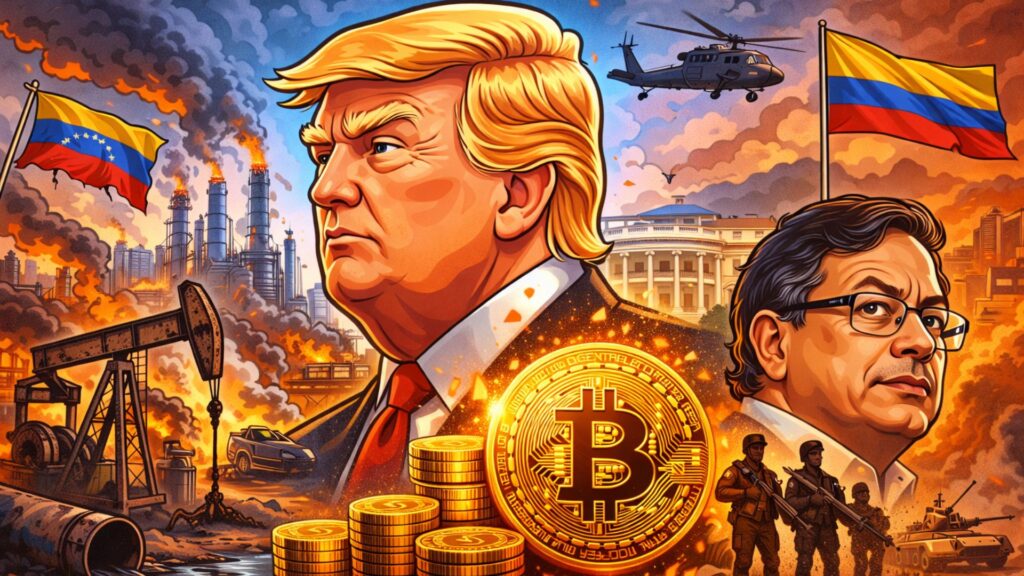
President Donald Trump’s promise to restart Venezuela’s oil engine with American backing has landed with a dull thud in financial circles.
While the political shock of Nicolás Maduro’s capture briefly reshaped headlines, investors and energy analysts remain unconvinced that Venezuela is anywhere close to a meaningful oil recovery.
Years of neglect, asset stripping, and institutional decay have turned what was once one of the world’s most powerful oil producers into a case study of long term decline.
At the same time, Trump’s rhetoric is no longer limited to Caracas. Fresh warnings aimed at Colombia, Mexico, and even Cuba have widened geopolitical uncertainty across Latin America. Markets are reacting in uneven ways.
Venezuela’s Oil Revival Faces Structural Damage and Investor Scepticism
The central problem for Venezuela is not leadership but infrastructure. Over more than a decade, the country’s oil system has suffered deep and persistent damage.
Ports are slow, pipelines are failing, refineries barely function, and oil fields have been left exposed to looting and neglect.
According to estimates cited by Bloomberg, rebuilding this system could cost more than $100 billion and take at least ten years. Even that timeline assumes steady governance and uninterrupted investment, conditions Venezuela has not enjoyed for a generation.
Francisco Monaldi, director of Latin American energy policy at Rice University’s Baker Institute, has described the scale of the task in blunt terms.
To return production to levels last seen in the 1970s, when Venezuela produced close to 4 million barrels per day, the country would need roughly $10 billion of investment every year for a decade.
Anything faster would require even more capital, at a time when confidence remains fragile and political clarity is limited.
Production currently sits around 1 million barrels per day, a fraction of Venezuela’s historical output.
This is despite the country holding the world’s largest proven oil reserves. The gap between reserves on paper and barrels delivered to market reflects the depth of decay across the system. In practical terms, Venezuela cannot reliably extract, process, or export oil at scale.
Conditions on the ground underline why investors remain cautious. During Nicolás Maduro’s twelve years in power, oil infrastructure steadily deteriorated. His removal does not repair broken pipelines or restore missing equipment.
At key ports, loading a single supertanker can now take up to five days, compared with one day just seven years ago. These delays add costs and undermine reliability, making Venezuelan crude less attractive even when prices are favourable.
The Orinoco Basin, one of the richest oil regions on the planet, offers a stark example. It holds close to half a trillion barrels of recoverable crude, yet much of it lies dormant.
Abandoned rigs dot the landscape, while usable equipment has been stripped and sold as spare parts, often in plain sight.
Underground pipelines have corroded or vanished entirely, sometimes removed and sold as scrap. Fires and explosions have destroyed critical machinery, leaving fields unsafe and unproductive.
Refining capacity tells a similar story. The Paraguana refinery complex, once the largest in Latin America, operates intermittently and at low rates.
Its four oil upgraders, essential for processing Venezuela’s heavy crude, remain shut down. Without them, the country cannot properly refine much of what it extracts, forcing reliance on imports and limiting export potential.
Banks are warning investors not to confuse political change with operational recovery. RBC Capital Markets analysts have cautioned that hopes of a swift return to 3 million barrels per day are misplaced.
Even under ideal conditions, with full sanctions relief and a smooth political transition, the path back would be long. Capital Economics has echoed this view, noting that Venezuela’s reserves mean little if the state lacks the capacity to develop them.
From a global perspective, the impact is also limited. Even if Venezuela were to reach 3 million barrels per day, analysts estimate this would add only around 2% to global oil supply.
That is meaningful but not transformative, particularly in a market shaped by OPEC decisions, US shale output, and broader geopolitical trends.
Oil majors are behaving accordingly. Chevron remains the only major US company actively operating in Venezuela, accounting for roughly 25% of current output under a special licence despite US sanctions.
Its public statements emphasise worker safety and asset protection rather than expansion. Exxon and ConocoPhillips, both of which saw their assets seized in the mid 2000s under Hugo Chávez, remain on the sidelines.
Neither has indicated any imminent return, reinforcing the view that confidence has yet to be restored.
Colombia Enters the Picture as Markets React Unevenly
While Venezuela’s oil challenges dominate the economic narrative, Trump’s recent comments have broadened the political risk landscape.
Following Maduro’s capture, the US president suggested that Colombia could be the next target of American action, citing ongoing cocaine flows into the United States.
He also signalled growing frustration with Mexico over cartel activity and described Cuba as vulnerable following the loss of Venezuelan oil supplies.
These remarks have injected fresh uncertainty into the region. Unlike previous crises that unfolded gradually, the Venezuela operation was executed quickly, limiting prolonged market panic.
Analysts note that this speed may have helped contain immediate disruption, but it has not removed longer term concerns about escalation.
Financial markets have responded in contrasting ways. Oil prices have remained sensitive but measured.
Goldman Sachs analysts have suggested that Venezuelan performance could swing Brent crude prices by around $2 per barrel in either direction in the short term, depending on changes in output.
Over a longer horizon, a recovery to around 2 million barrels per day by 2030 could knock approximately $4 per barrel off prices relative to current projections. These are notable shifts, but they depend on sustained progress that remains uncertain.
Bitcoin, meanwhile, has moved in the opposite direction. Following the Venezuela operation and Trump’s comments on Colombia, Bitcoin climbed above $93,000, rising more than 3% in a matter of days.
Market observers have suggested that the move reflects Bitcoin’s growing role as a hedge against geopolitical instability rather than a direct reaction to any single event.
This divergence highlights a broader pattern. Traditional markets are weighing concrete factors such as infrastructure, production capacity, and fiscal risk.
Crypto markets, by contrast, are responding to uncertainty itself, treating geopolitical tension as a signal rather than a threat. The result is a fragmented response, where different assets tell different stories about the same political developments.
Adding to the complexity is Trump’s continued interest in Greenland, which he has again described as vital to US national security.
Danish and Norwegian officials have rejected any suggestion of a sale, but the comments reinforce a sense that American foreign policy under Trump remains unpredictable. For investors, this unpredictability is now part of the pricing environment.
Conclusion
Trump’s push to revive Venezuela’s oil industry runs headlong into the reality of long term structural damage and fragile investor confidence.
Years of neglect have left the sector broken rather than paused, and rebuilding it would demand time, money, and stability that cannot be assumed. At the same time, widening threats toward Colombia and neighbouring states are reshaping regional risk perceptions.
Oil markets remain cautious and analytical, while Bitcoin’s rise reflects a search for insulation from political uncertainty. Together, these responses suggest that markets are listening closely to events, but they are placing far more weight on fundamentals than on bold promises.